








How to play FreeCell
All 52 cards are in view from the start. Move them to the four foundations by suit, Ace to King, using the four free cells as temporary space.
History & origin of FreeCell
FreeCell was created by Paul Alfille in 1978, who programmed it on PLATO — the University of Illinois’ pioneering educational computer system, one of the first with graphical, color displays. Alfille started from an older game called Baker’s Game (which builds by suit) and switched the rule to alternating colors, which made nearly every deal winnable.
That change gave FreeCell its identity: with all cards in view and almost always a solution, it became the solitaire of pure reasoning — if you lose, you lose to a mistake, not to bad luck.
Worldwide fame came through Jim Horne, who wrote a Windows version; Microsoft went on to ship FreeCell with Windows (from the Entertainment Pack to Windows 95), putting it on millions of computers.
Facts about FreeCell
- Almost every FreeCell deal is solvable. Of the 32,000 numbered games in Microsoft’s classic version, only one — number 11,982 — has been proven impossible to win.
- Because it rewards calculation and patience, FreeCell was informally used as a “focus test” — and back then people joked that running it tested the PC’s memory.
- Unlike Klondike, there is no luck of the draw here: the whole deck is face-up from the very start.
- The more free cells and empty columns you keep, the larger the group of cards you can move in a single go.
How to play FreeCell step by step
- Goal: bring all 52 cards to the four foundations, each by suit from Ace to King. Everything starts face-up.
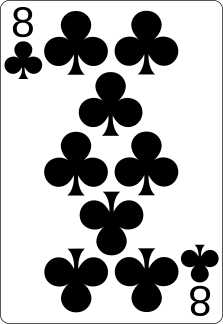
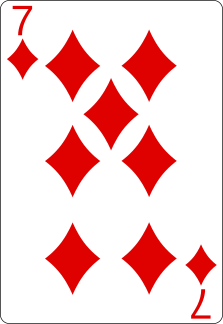
- In the tableau, stack down in alternating colors (a black 8 takes a red 7, and so on).
- The four free cells (top corner) each hold one card — use them as temporary parking to free up moves.
- You can move a whole sequence at once, but the limit depends on space: the more free cells and empty columns, the bigger the group.
- Send Aces and 2s to the foundations as they appear, but don’t empty the cells without a plan — they are your most valuable resource.
- Since almost every deal has a solution, think before you act: with patience you can see the path to the end.